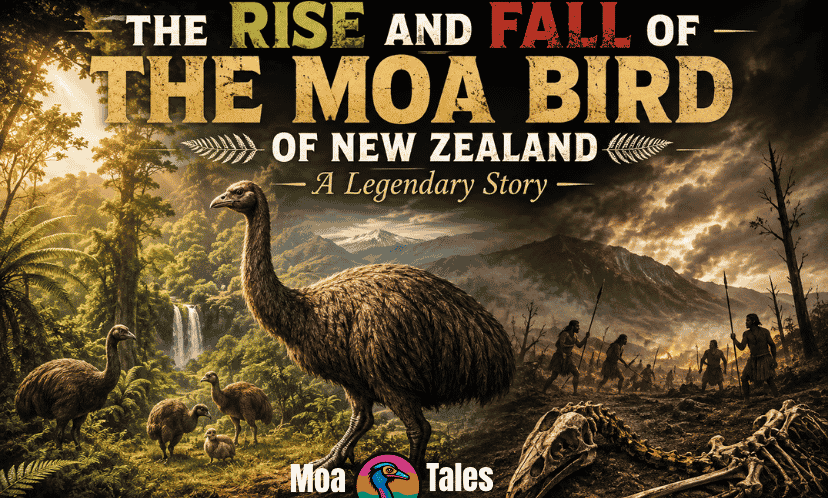
Imagine walking through the forests of New Zealand hundreds of years ago, when the land was quiet and almost completely free of people. Between the trees, a strange giant might appear: a huge, feather-covered bird walking slowly across the forest floor, its long neck moving from side to side as it searched for leaves and fruit. The moa bird of New Zealand was real, not a creature from a legend. For millions of years, these extraordinary flightless birds lived only in New Zealand, growing into different species that occupied forests, wetlands, grasslands, and mountain country. By the time humans arrived, moa had become some of the most remarkable animals in the entire country.
Moa were giants of a lost world.

Moa were not a single species. Scientists recognize nine species of moa, ranging from birds smaller than a large turkey to giant moa weighing more than 200 kilograms. The largest female giant moa could be two meters tall, while some smaller species were less than half a meter tall. Their sizes varied so much that it is easy to think of them as several completely different birds rather than members of the same group.
The story of their evolution stretches back millions of years. Genetic and fossil evidence suggests that the common ancestor of the moa group lived in New Zealand about 30 million years ago, while the oldest known moa fossils are much smaller. Over enormous stretches of time, different populations adapted to different environments and developed their own shapes, sizes, bills, legs, and feeding habits.
What Did a Moa Actually Look Like?
The first thing that surprises people is that a moa did not simply look like an enormous ostrich. Modern reconstructions suggest that many moa had a rounded or domed back, with the neck rising from the slope of the body. Their heads were surprisingly small for such huge animals. A giant moa weighing more than 200 kilograms could have a skull only around 23 centimetres long.
They had no wings at all not even the tiny vestigial wings found in other flightless birds. Their feathers were rough and furry, somewhat like those of a kiwi. The few preserved feathers available to scientists suggest that at least some moa had dark feathers that became lighter toward the tips. One species, the upland moa, even had feathers extending down toward its ankles, probably helping it cope with the cold mountain environment.
Their feet were equally remarkable. Each foot had three toes pointing forward and a small rear toe or spur. The legs were powerful, and some species had very broad, heavy feet. These were birds built for walking rather than flying, and their bodies were supported by massive bones and strong muscles.
The Moa Had Different Beaks for Different Foods

Moa were herbivores, but they were not simply grass-eaters. Different species had different bills and digestive adaptations, allowing them to exploit different plants. Evidence from fossilised droppings, stomach contents, and gizzard remains shows that moa ate leaves, fruit, shrubs, herbs, grasses, and twigs.
Some species were adapted to dense forests, while others lived in open country or high mountain environments. Giant moa could be found from lowland areas to subalpine zones, while upland moa specialised in colder mountain habitats. In this way, several species could share the same broad region without all competing for exactly the same food.
They also played an important role in the ecosystem. Before humans arrived, moa were among New Zealand’s major plant-eaters, filling ecological roles that large browsing mammals occupy elsewhere.
How Many Moa Were There?
This is one of the most fascinating questions—and one scientists cannot answer with complete certainty. Estimates have changed dramatically because researchers use different methods.
One genetic study estimated that all moa species together may once have numbered in the millions. More recent ecological modelling produced a lower but still enormous estimate of roughly 500,000 to 2.5 million moa across New Zealand about 1,000 years ago, before human settlement. That would have meant moa were not rare animals hiding in a few remote forests. They were widespread across the country.
Imagine that landscape: hundreds of thousands, perhaps more than a million, of these flightless giants moving through different parts of New Zealand.
They were not necessarily travelling together in enormous herds like wildebeest. Evidence is limited, but some researchers suggest moa may have lived as pairs or in small family groups, while genetic evidence also shows that related individuals sometimes occurred close together. Their exact social behaviour remains one of the mysteries of their lost world.
What Happened When a Moa Had a Baby?
Moa reproduced much more slowly than many modern birds. Only a small number of moa eggs have survived, but the eggs that have been discovered are astonishingly large. The largest known moa egg, attributed to the South Island giant moa, measured about 24 by 17.8 centimetres. Other species laid considerably smaller eggs.
Scientists have even discovered bones of moa embryos and newly hatched chicks. Research suggests that moa chicks grew unusually slowly compared with modern ostriches and emus. Some species could take several years to reach adulthood, and certain moa may have required almost a decade to reach skeletal maturity.
That slow growth became one of their greatest weaknesses.
A moa population could not simply replace hundreds of adults killed by hunters within a single breeding season.
Evidence from some nesting sites suggests that upland moa built shallow nests from twigs, bark, and vegetation, sometimes in rock shelters. They probably laid only one or two eggs in a breeding season, and researchers believe the male may have incubated the eggs, as happens in several living ratites.
And What Did a Moa Sound Like?
This is something we can never know with absolute certainty.
No recording of a living moa exists, of course. Scientists have tried to reconstruct its call using the shape of the bird’s windpipe and comparisons with living birds such as cassowaries. Some moa had unusually long windpipes, including loops extending deep into the body, which could have produced deep, resonant sounds.
So the forests of ancient New Zealand may have carried surprisingly low and powerful calls from these giant birds. But any recreation remains an educated reconstruction, not a recording of the real animal.
The Predator That Ruled the Sky
For most of their existence, moa had very few natural enemies. Their greatest known predator was Haast’s eagle, an enormous extinct eagle that lived in New Zealand.
This was an extraordinary predator-prey relationship. Haast’s eagle was powerful enough to attack even large moa. For thousands of years, the two species existed as part of the same ecosystem. The eagle hunted, the moa browsed, and the forests supported both.
Then another predator arrived.
Humans.
The Day the Old World Began to Disappear
Polynesian ancestors of Māori arrived in New Zealand around the late 13th century. They entered a land filled with animals that had never experienced human hunting.
Moa were large, slow-growing, flightless, and unable to escape into the air. They became an immediate source of meat. Archaeological sites contain huge quantities of moa bones, while eggshell remains show that people also collected and consumed their eggs. Their bones were shaped into tools, fish hooks, ornaments, and other objects, while feathers and skins were used for clothing.
The forests were changing too. Human settlement brought hunting, burning, and habitat modification. Within a surprisingly short period, an animal that had survived for millions of years was pushed toward extinction.
Research using radiocarbon dates suggests that moa extinction occurred in the early to mid-15th century, roughly within 1–2 centuries of human settlement. Some studies estimate the final extinction process at around 60–200 years.
The timing is astonishing.
Millions of years of evolution.
Hundreds of thousands or perhaps millions of birds.
And then, within a few human generations, nothing.
The Last Moa
By the time European explorers began arriving in New Zealand centuries later, the moa had already disappeared. There were no living giant birds waiting in unexplored forests.
Only their remains survived.
Bones lay beneath soil and swamp. Feathers survived in unusually dry caves. Eggshells remained buried in archaeological sites. In some rare discoveries, even skin, muscle, tendons, and feathers were preserved.
For moatales, this is where the story becomes especially fascinating: scientists can reconstruct parts of an animal’s life from these fragments. A single foot can reveal how it walked. A beak can reveal what it ate. An egg can reveal something about reproduction. Ancient DNA can reveal relationships between individuals and species.
A Giant That Became a Legend

The moa was not the king of New Zealand in the literal sense, but for millions of years it was one of the dominant large herbivores of the islands. It helped shape vegetation, occupied habitats from forests to mountains, and lived alongside one of the world’s greatest birds of prey.
Its disappearance changed the ecosystem forever.
Today, museums can place a moa skeleton beside a human visitor and reveal just how enormous these birds really were. A child standing next to the bones can look up at a creature that once walked through the same land but now exists only in fossils and scientific reconstructions.
The moa bird of New Zealand survived millions of years of environmental change, evolved into a remarkable family of giant flightless birds, raised chicks from enormous eggs, walked on powerful three-toed feet, and lived across the forests and mountains of Aotearoa. Then, after the arrival of humans, its world changed faster than the species could adapt. The moa disappeared roughly 600 years ago, but its bones still tell the story of a lost New Zealand and moatales can keep that extraordinary story alive for a new generation.